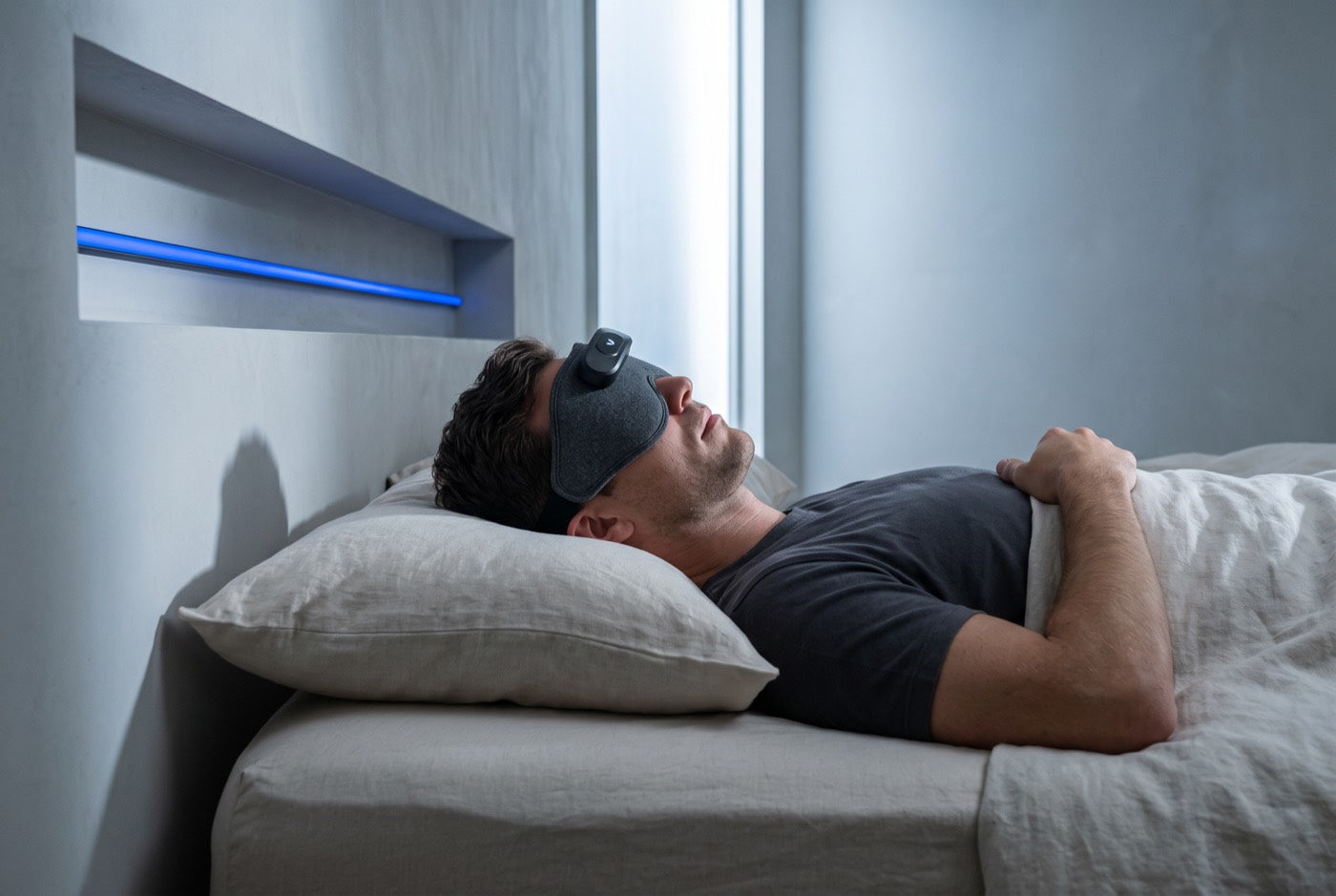
The science · audio-visual stimulation.
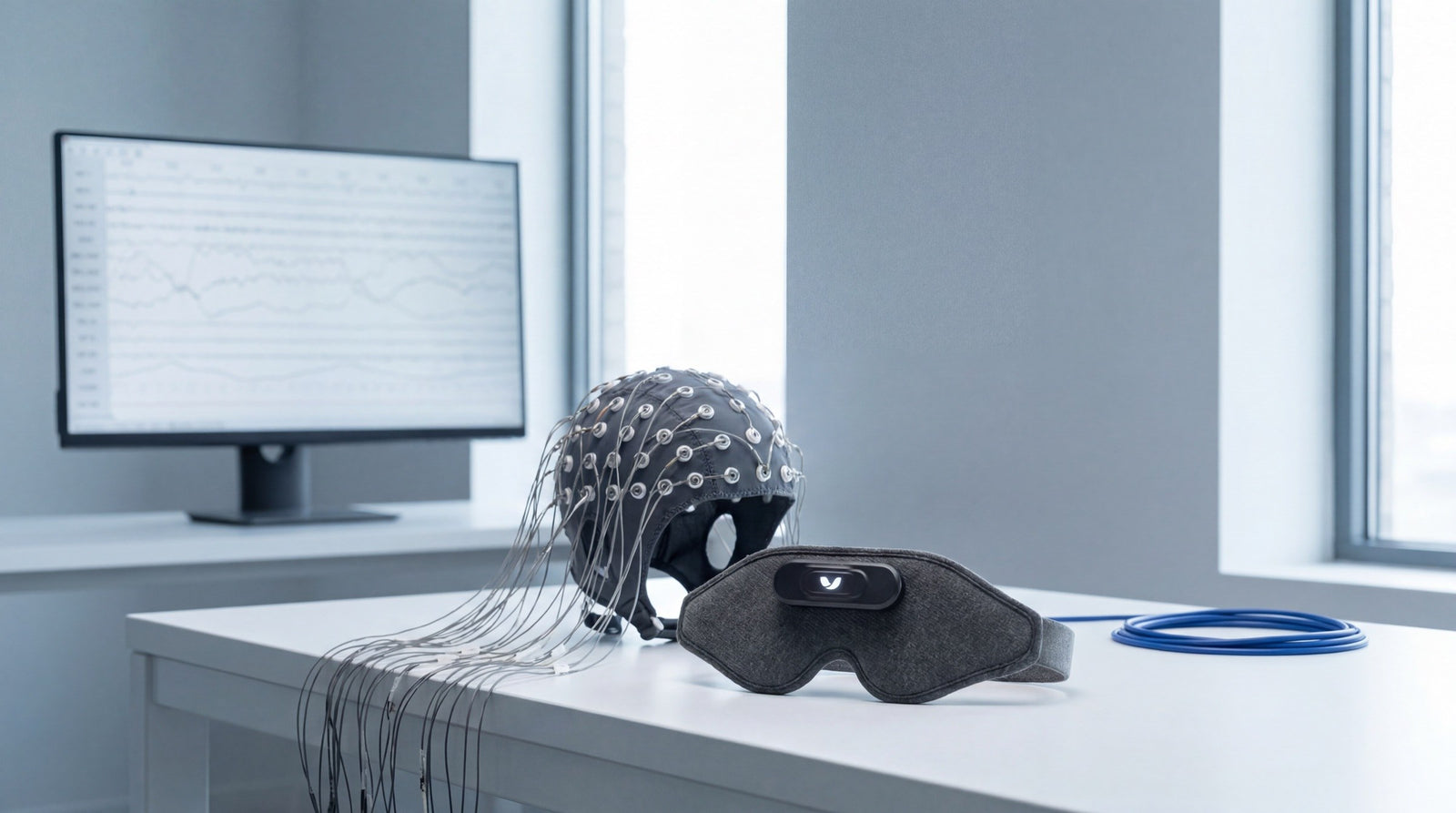
One exacting instrument.
Grounded in decades of neuroscience research.
Your brain has a
rhythm.We work with it.
Your brain continuously produces patterns of electrical activity: brain waves. They vary depending on whether you are alert, relaxed, drowsy or asleep. Rhythmic light and sound, delivered at a steady frequency, can guide brain activity toward similar ranges, a process called neural entrainment, grounded in decades of research across sleep, stress, focus and recovery.
Rhythmic light through the mask as a gentle flicker, with matched binaural or isochronic tones through the headphones. Delivered together, light and sound are engineered to produce a larger response than either alone.
The brain’s tendency to synchronize its electrical rhythms to an external one, the way you end up nodding along to a beat without deciding to. The effect is measurable on EEG (Notbohm and Herrmann, Journal of Neuroscience, 2016).
Steady-state visually evoked potentials: EEG-measurable evidence that the brain is responding to the stimulus itself. Alpha-band entrainment at 10 Hz is well documented in the published literature (Rahmani, Romero Lauro and Pisoni, Brain Sciences, 2025).
02 / The bands · five frequency ranges

03 / The instrument · light, tuned like an instrument.
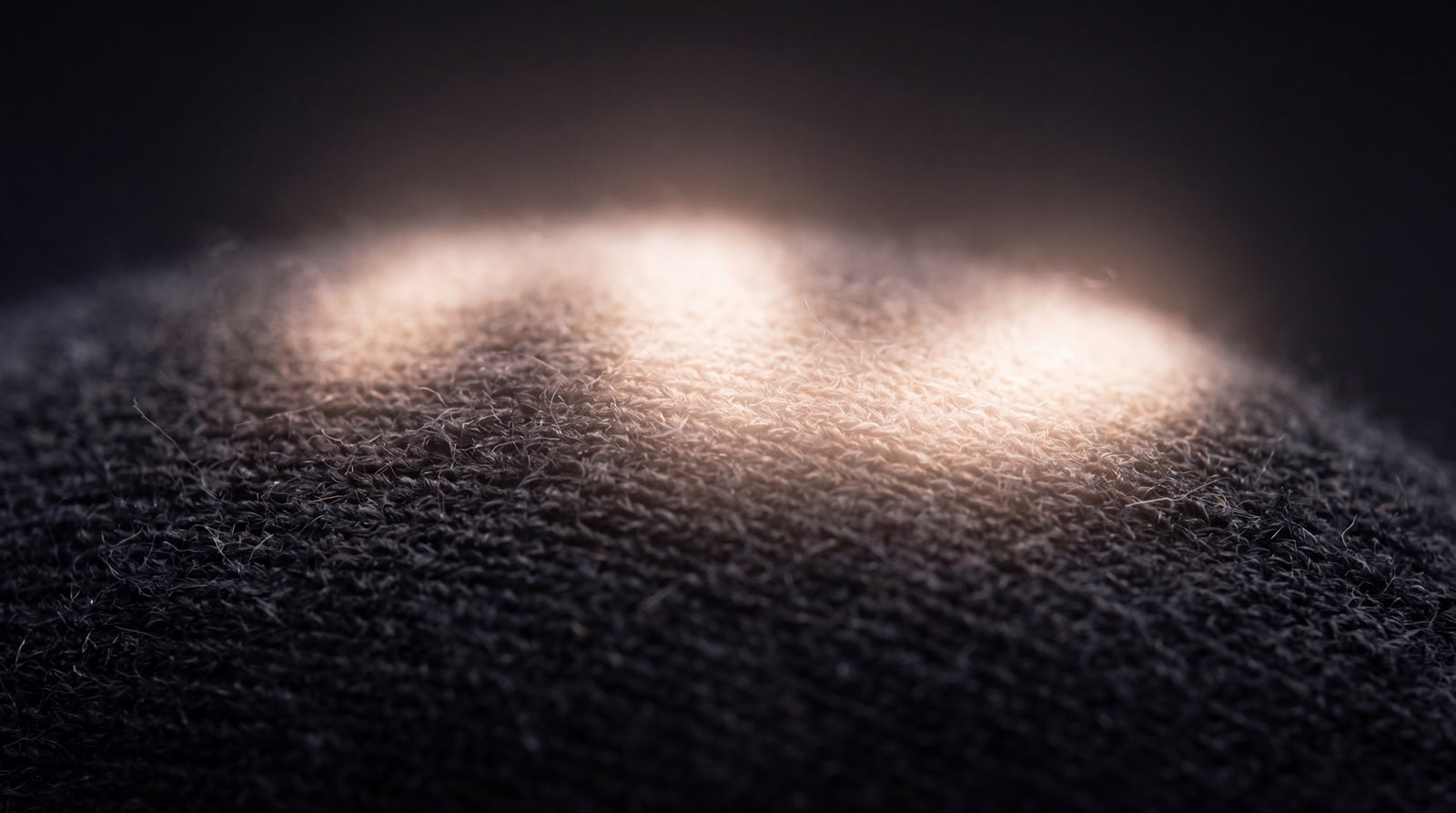
Rhythmic light through the mask. Matched tones through the headphones.
04 / Our data · Reported as signals, not proof.
From our in-lab study in Beijing, February 2026. A single daytime session, in a room not set up for sleeping. Self-report from 93 participants, physiological measures from 71.
Effect size (dz): 0.2 is small, 0.5 moderate, 0.8 large. Early signals from one in-lab study, not proof of efficacy.
05 / Standards · Good science. No shortcuts.
Safety first. Always.
All stimulus parameters fall within established photic safety limits. We never push beyond what the evidence supports.
Claims follow data.
We report what we find, not what we want to find. Pilot data is reported as pilot data. We stay one step behind the evidence.
Open research.
We are committed to publishing our findings and contributing to the broader understanding of AVS-based neuromodulation.
06 / Research Collaboration · The door is open.
Domayn runs its own studies in the lab, and we work with independent researchers who put the mechanism through its paces on their own terms. We want more of that, not less. If you study sleep, attention, or the nervous system and see a question worth asking together, write to us.

07 / Questions · The science, asked directly.
What is the science behind the Mask?
The Mask uses audio-visual stimulation (AVS): rhythmic light and sound delivered through the mask and headphones. Your brain continuously produces patterns of electrical activity, brain waves, that shift depending on whether you are alert, relaxed, drowsy, or asleep. AVS works on a well-studied principle: rhythmic external cues, delivered at a steady frequency, can guide brain activity toward similar frequency ranges. That process is called neural entrainment.
The Mask uses structured light-and-sound protocols designed for specific moments: waking, focus, winding down, and sleep. The table above sets out the frequency bands the brain works across.
What is neural entrainment, and why does it matter?
It is the brain’s tendency to synchronize its electrical rhythms to an external rhythm: light, sound, or both. You have felt a version of it. When a song comes on and you find yourself nodding along without deciding to, your system has locked onto the beat. AVS applies the same principle to brain-wave activity, a well-documented effect measurable on EEG (Notbohm and Herrmann, Journal of Neuroscience, 2016). It matters because it offers a non-pharmacological way to move toward the state you need: without drugs, without willpower, without technique.
What is audio-visual stimulation (AVS)?
The combined delivery of light and sound at matched frequencies to drive neural entrainment. The light is delivered through the mask as rhythmic pulses your closed eyes perceive as a gentle flicker; the sound is delivered through the headphones as binaural or isochronic tones. Delivered together, light and sound are engineered to produce a larger response than either on its own.
What is SSVEP, and why is it relevant?
SSVEP, the steady-state visually evoked potential, is the measurable brain response produced when the visual system is stimulated at a consistent frequency. In plain terms, it is EEG-measurable evidence that the brain is responding to the stimulus itself. Alpha-band entrainment at 10 Hz is well documented in the published literature (Rahmani, Romero Lauro and Pisoni, Brain Sciences, 2025).
To be clear about whose evidence this is: it is published research, not ours. We have not run an SSVEP study on the Mask.
EEG, an electroencephalogram, is a non-invasive test that records the brain’s electrical activity with small sensors on the scalp.
Is this real science, or wellness marketing?
It is real. AVS is a mechanism grounded in decades of neuroscience research spanning sleep, stress regulation, focus and recovery. To be precise: the research grounds the mechanism, neural entrainment, not any one product. What we can say about the Mask specifically, we say with our own in-lab data, and we say what that data does not show as well.
What does your own data show?
From our in-lab study in Beijing, February 2026: self-reported anxiety fell and relaxation rose across a single daytime session, heart-rate variability rose while heart rate fell, and a summary score from EEG showed reduced vigilance that returned toward baseline after the session ended. Self-report figures are from 93 participants; physiological measures from 71. We report these as early signals, not proof of efficacy.
08 / Continue · From the science to the instrument.
The science is the ground. The Mask is the instrument built on it. See it in full, or put your name down and we'll tell you the moment access opens in your city.